
Role Of Member Of Parliament – Legislation
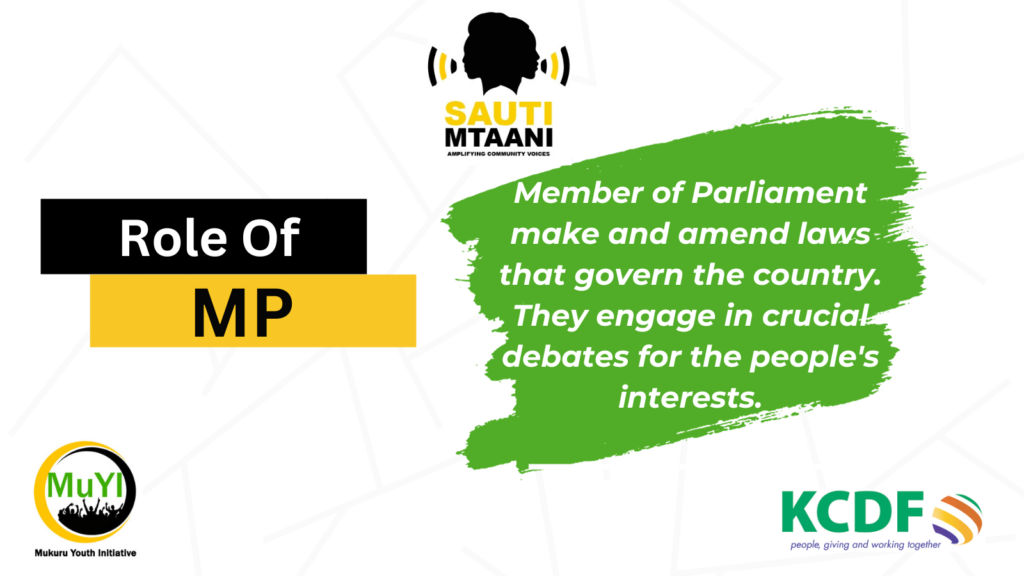
One of Parliament’s fundamental and indispensable functions is the enactment of laws, in accordance with its legislative authority outlined in Article 94 of the Constitution. Members of Parliament bear the pivotal responsibility of creating and formulating legislation, effectively wielding their legislative power to fulfill this vital role. The Parliament of Kenya operates in accordance with the Constitution by representing the will of the people and upholding their sovereignty, with legislation being a key aspect of this representation.
Your Member of Parliament should actively participate in all stages of the legislative process. There have been instances where Members of Parliament have attended all readings except the final one, where they are required to vote. Such absences mean that your input and representation are missing in the decision-making process. This emphasizes the importance of electing someone who prioritizes your interests, as they should seek and consider the views and inputs of their constituents before passing a bill.
Unlike county governments, where MCAs legislate laws affecting county-level governance, Members of Parliament are responsible for passing laws that impact the entire country. The initiation of a bill must be undertaken by a Member of Parliament.
It is crucial to differentiate between a legislative proposal and a Bill in the legislative process. A legislative proposal serves as an initial concept for a potential Bill, while a Bill is a formalized and publicly disclosed draft of a proposed law intended for consideration and introduction in the National Assembly. Both legislative proposals and Bills typically aim to achieve specific objectives, whether it involves introducing new legislation, amending existing laws, or repealing certain laws altogether.
When a Member or a Committee of the National Assembly intends to present a Bill in the House, a mandatory step involves submitting the legislative proposal to the Speaker for approval. This proposal is typically accompanied by a memorandum that articulates the Bill’s objectives and justifications.
Once a Bill has successfully passed through the House, the Speaker presents it to the President in a form known as the Vellum. The President has the option, within fourteen days, to either assent to the Bill or refer it back to the House with a memorandum outlining any reservations or concerns. This marks the final step in the legislative process before a bill becomes law.
The Sauti Mtaani Project aims to bring enlightenment to our community by educating them about the various roles and responsibilities of duty bearers. We believe that it is only through a clear understanding of these roles that we can effectively hold them accountable and pose pertinent questions. This project is committed to empowering community members, enabling them to engage actively with their elected leaders. It seeks to enhance their knowledge of social accountability, allowing us to use art as a tool to address community issues efficiently and creatively. Jua Leader Wako.


Facebook Comments